



Unpack the Vision
The three pillars below outline the key channels that ORR’s National Executive Forum on Health and Outdoor Recreation will use to explore both quick-turn solutions and the longer-term policy pathways required to scale them nationally.
National Executive Forum on Health and Outdoor Recreation, May 2026


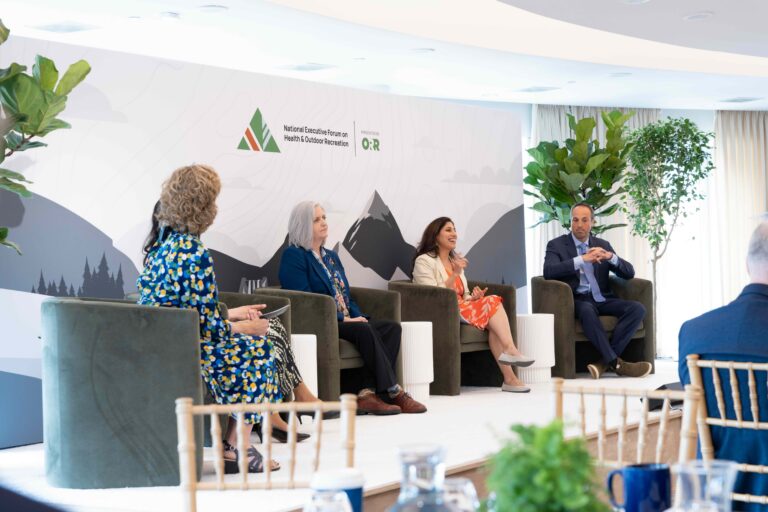
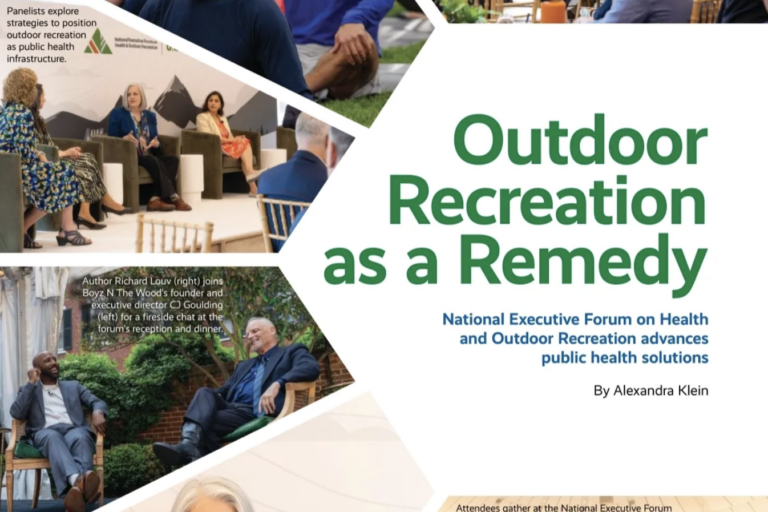
ORR hosted a first-of-its-kind National Executive Forum on Health and Outdoor Recreation May 2026 in Washington, D.C. This invite-only Forum united leading outdoor recreation CEOs with CEOs from healthcare, pharmaceuticals, experts on physical and mental health, wellness, and social vitality and state and national policy makers. Drawing on evidence-based research and lessons from the U.S. and abroad, the convening charted a forward-looking agenda for harnessing outdoor recreation as a solution to the nation’s pressing health challenges. From lowering health care costs to improving mental resilience, gut health, reducing rates of diseases like obesity and diabetes, and enhancing overall well-being, it’s time to elevate the $1.3 trillion outdoor recreation economy as part of the solution and ensure its benefits are central to the national dialogue on health and wellness.
Hosting the National Executive Forum on Health and Outdoor Recreation is part of ORR’s ongoing efforts to convene industry leaders and government officials and provide thought leadership and cross-sector collaboration. This Forum outlined the myriad ways that increasing access and opportunities for outdoor recreation positively impacts society, public health, and economic development as well as opportunities to catalyze further change across multiple sectors. The benefits of outdoor recreation need to be brought into the national dialogue as we tackle our nation’s challenges and design and implement policies that improve the health and well-being of everyone.
This Forum comes at a pivotal time for public health and outdoor recreation’s role as a solution. Even before the COVID-19 pandemic, mental health challenges were the leading cause of disability and poor life outcomes among young people, with up to 1 in 5 children and adolescents aged 3 to 17 years in the United States having a reported mental, emotional, developmental, or behavioral disorder. CDC data from 2023 show that in 23 states more than one in three adults (35%) has obesity. Heart disease is the leading cause of death for men, women, and people of most racial and ethnic groups, accounting for nearly 1 in 5 deaths in 2022. In 2023, the U.S. Surgeon General in an advisory described an “Epidemic of Loneliness and Isolation” across the country. Time outside and the provision of outdoor access for all has shown notable effects in research in addressing these trends and more, and now is the time to scale and invest in these impacts more broadly.
To learn more about the Forum, contact orr@recreationroundtable.org.
Forum Sponsors

Full Health Vision (Plain Text)
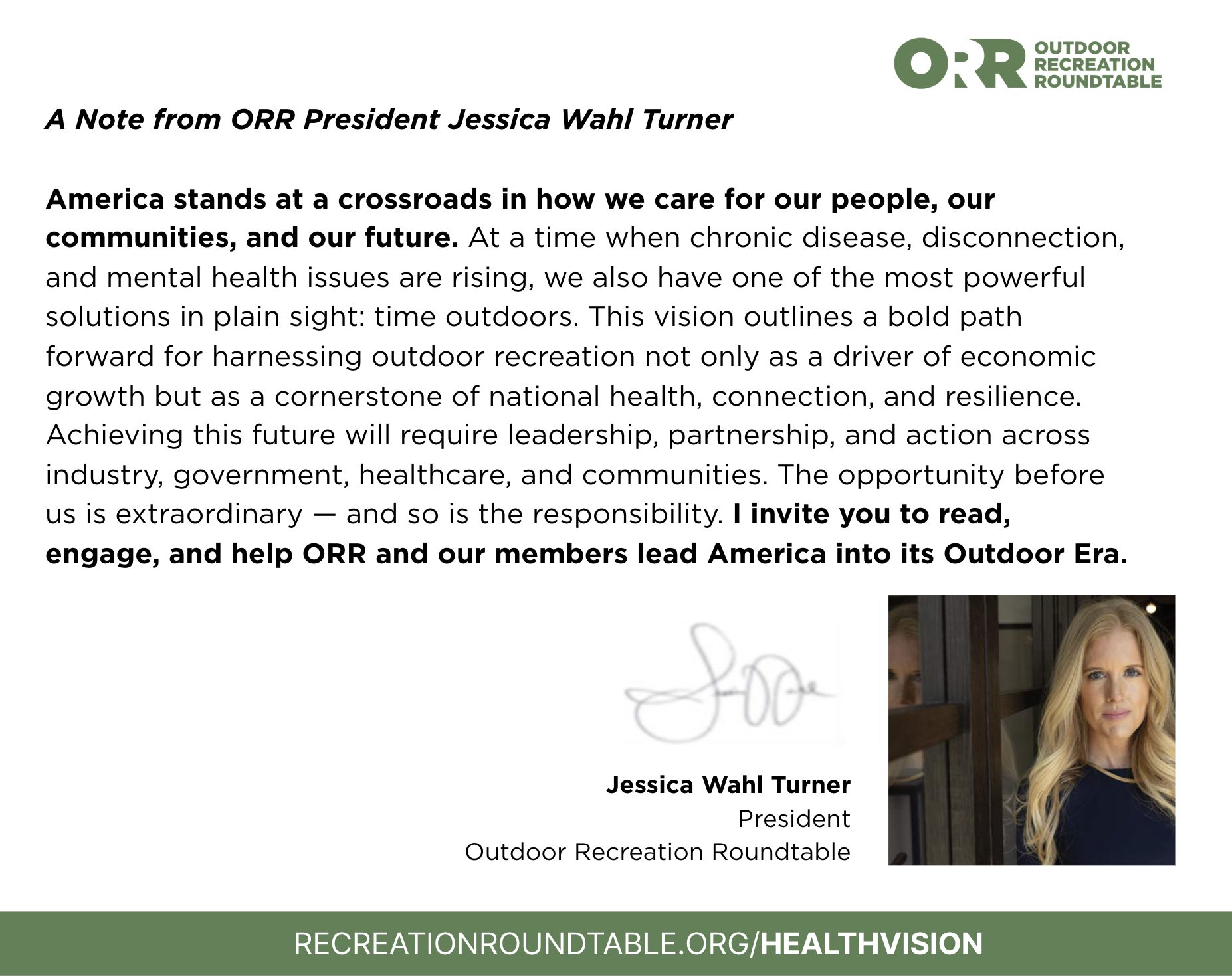
America’s Outdoor Era
Outdoor Recreation Roundtable’s Vision for a Healthier America
One of America’s greatest opportunities for public health intervention lies outside our front doors.
Health leaders and policymakers, concerned by troubling rates of disease and rising costs, are seeking upstream interventions to improve Americans’ health and resilience before illness takes root. The outdoor recreation economy provides a readily available solution. As decades of research illustrate, a national strategy to help Americans get outside in urban and rural communities alike can improve health outcomes, prevent costly downstream interventions, and grow a key sector of the U.S. economy.
This is the vision for America’s Outdoor Era.
Time spent recreating outdoors delivers a collection of health outcomes that no indoor or clinical intervention can fully replicate, including:
- A sense of awe that reduces stress and boosts emotional resilience and social outcomes
- Enhanced immune function, heart function, and gut health
- Healthy childhood development through free and exploratory play
- Increased physical strength, vision, and mobility
- Improved mental health and cognitive clarity
- Reduced disease rates and lowered healthcare costs
- Stronger communities built on cooperation and civic engagement
The outdoors can be a great equalizer, a place where people connect and communicate across differences, practice cooperation and teamwork, strengthen community bonds, build resilience and confidence, and practice mindfulness. It’s a place for kids to be kids—getting dirty, exploring freely, taking healthy risks, and discovering their capabilities. From neighborhood walks and time in local green spaces to adventures on waterways and explorations of remote backcountry settings, outdoor experiences create lifelong benefits in ways that no other environment can.
Yet despite all that we know, it is becoming easier than ever to spend our lives indoors — a pattern with growing implications for long-term health, workforce readiness, and social cohesion. Rising screen use contributes to stress, anxiety, loneliness, and inactivity, especially among youth. Meanwhile, U.S. healthcare spending surpassed $5 trillion in 2024, driven in large part by the treatment of preventable chronic disease. If current trends continue, we risk becoming more indoor-bound, less active, and more disconnected to one another and our natural world — while continuing to shoulder the financial costs that follow.
We have a choice. Will we accept a future where nature disconnection, loneliness, and chronic illness become our norm? Or will we commit to building a country and health system where time outdoors is a core part of what it means to live well — a shared space where the pursuit of happiness outlined in our founding documents comes alive?
Leaders across the outdoor and health industries, and policymakers at all levels, have the opportunity to champion a national vision for America’s Outdoor Era — positioning outdoor recreation as essential health infrastructure. This is the moment to advance outdoor recreation’s role in value-based care, prevention-first health policy, and long-term population health outcomes that will benefit Americans in urban and rural communities for generations to come.
A future like this is closer than we think. The evidence is growing. The infrastructure exists. Congress has already begun laying the groundwork. The bipartisan EXPLORE Act created new authorities to expand the role of outdoor recreation in education, innovation, and public-private partnerships, opening doors for scalable health applications. The Legacy Restoration Fund directs billions of dollars into our recreation infrastructure each year. What remains is alignment — across health systems, insurers, educators, planners, and lands stewards — to activate a solution already within reach.
Integrating outdoor access into health strategy is a practical, bipartisan, and scalable opportunity. By aligning policies, investments, and partnerships across sectors, we can improve public health, reduce long-term healthcare costs, steward the lands and waters that sustain us, and unlock a new era of wellbeing in America.
The three pillars below outline the key channels that ORR’s National Executive Forum on Health and Outdoor Recreation will use to explore both quick-turn solutions and the longer-term policy pathways required to scale them nationally.
Infrastructure and Investment
In America’s Outdoor Era, we will guarantee sustained funding and transformative policy to ensure safe, affordable, and convenient access to the outdoors for all Americans. This will help build a future in which recreation infrastructure is core to preventative care and treatment.
This includes:
- Accessibility and safety improvements, technology utilization, and innovations in recreation infrastructure to ensure access for all
- Active transportation networks (sidewalks, bike lanes, transit-to-trails, safe routes to schools and parks, and accessible parking)
- Inter-regional recreation connectivity (regional trail systems, long-distance water trails, and connected recreation corridors)
- Long-term recreation funding solutions across the front door-to-backcountry spectrum in local, state, and federal governments (including Legacy Restoration Fund and Recreational Trails Program, among others)
- Park, green, and blue space proximity to all Americans, utilizing public and private recreation opportunities
- Public-private partnerships between governments, public and private landowners, and recreation businesses/organizations to expand access
- Recreation infrastructure in schools, workplaces, healthcare facilities, and neighborhoods as venues to promote time outside (green schoolyards, walking paths, hospital campus trails, and restorative green spaces)
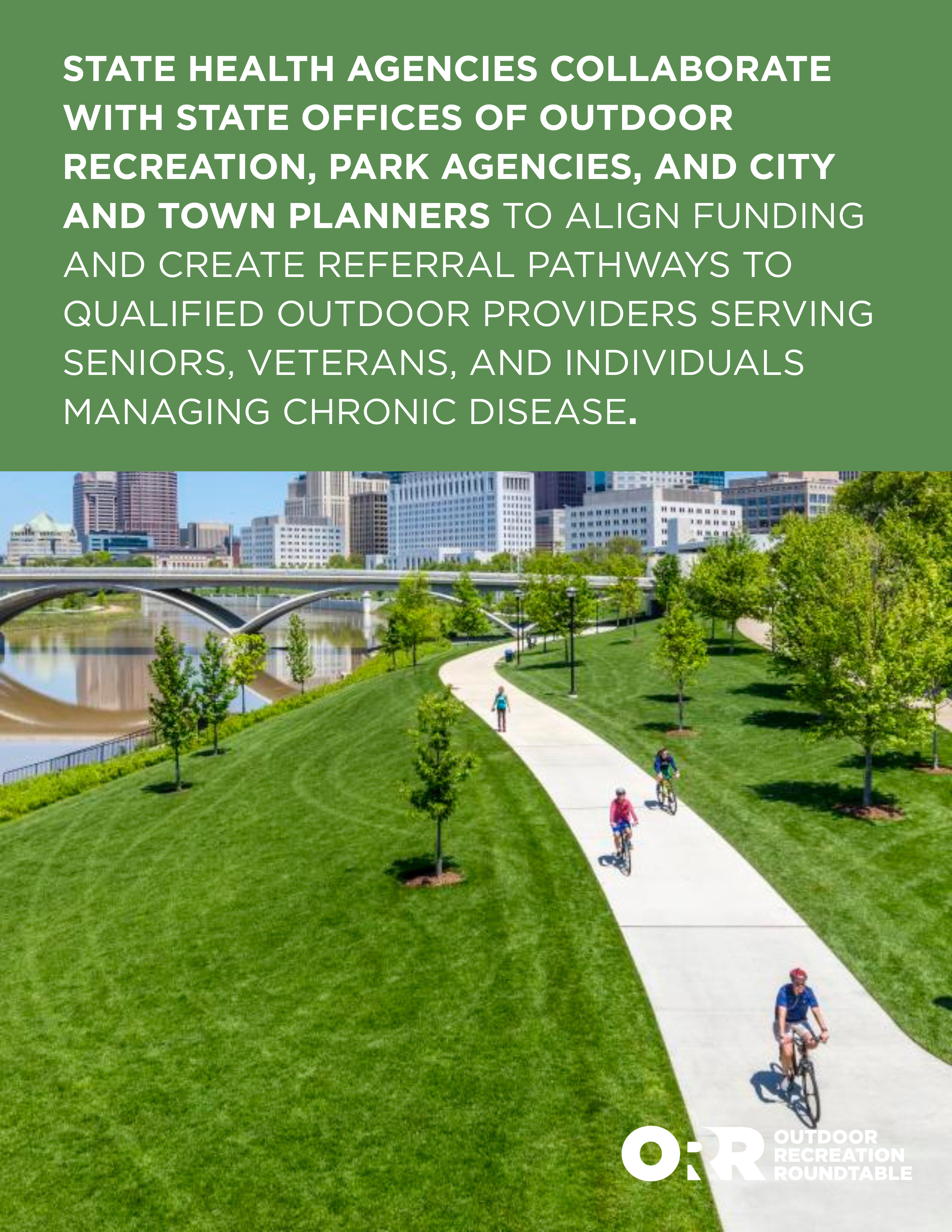
- State-level partnerships between State Offices of Outdoor Recreation (ORECs), State Health Agencies, park and public lands agencies, and planners to align infrastructure investment with measurable public health outcomes
- Weather and climate-resilient outdoor recreation infrastructure (trails, campgrounds, marinas, boat launches, ski hills, climbing areas, waterways, etc.)
- Workforce development pathways that support the next generation of outdoor professionals with professional development and career mobility
Culture and Messengers
In America’s Outdoor Era, we will shift norms for how Americans live, work, play, and raise their kids through media, sports, retail, technology, education, and trusted influencers. This will help mainstream time outside as core to our health and American identity.
This includes:
- Digital platforms and community technologies designed to reduce friction to participation — helping people discover, plan, and connect around outdoor experiences while minimizing unnecessary screen time
- Facilitated outdoor experiences (guides, outfitting, interpretation, health and wellness treatments)
- Family-centered, accessible programming from beginning to expert to build lifelong engagement with the outdoors
- Large-scale communications and public awareness campaigns that promote time outside as a pathway to health and well-being
- Outdoor-oriented hospitality destinations
- Participation in faith-, military-, civic-, and affinity-based outdoor communities
- Prominent voices for health decisions (celebrities, health influencers, athletes)
- Public health education and youth outdoor programming (schools, camp systems, childcare, after-school) to position time outside as a foundational life skill for resilience, emotional regulation, and attention
- Workplace norms and culture for employee resilience and burnout reduction
Health Systems and Institutions
In America’s Outdoor Era, we will treat time outside as a core health intervention along the care continuum by embedding nature into healthcare and public health institutions. This will help unlock new partnerships, funding streams, and measurable outcomes that directly align with existing health priorities and long-term prevention goals.
This includes:
- Alignment with existing clinical health metrics and indicators to support medical providers in using outdoor recreation as a tool
- Clinical integration pathways and Outdoor Rx toolkits that train doctors, nurses, physical and occupational therapists, and social workers in the value of time outside to our health
- Employer and union benefit programs that reward outdoor activity and support active time outside for employees and families
- Insurance and payer incentives that recognize outdoor activity — and the specialized equipment, instruction, and program access that enable it — as eligible for premium reductions, reimbursement, and condition-management programs
- New federal authorities under the EXPLORE Act — particularly Section 155’s pay-for-performance framework — to enable insurers, employers, and private capital partners to invest in evidence-based outdoor wellness programs tied to measurable reductions in healthcare costs
- Pathways for hospitals and insurers to invest community benefit dollars, prevention funds, and population health budgets into recreation infrastructure and programming
- Referral pathways and partnership models that connect healthcare providers with qualified outdoor recreation professionals and organizations equipped to deliver safe, structured programs
- Senior and aging-in-place health models that use time outside to address cognitive decline, mobility, isolation, and fall prevention
- Veterans’ and military community health models that use outdoor rec to support PTSD recovery, social integration, workforce development, and lifelong well-being
A VISION OF FUTURE HEALTH THROUGH OUTDOOR RECREATION




NATIONAL WEBINARS
Nature as Medicine: The Lesser-Known Physical Health Benefits of Time Outside
NATIONAL WEBINARS
Building a More Resilient Society: How Outdoor Recreation Supports Mental Health
Health and Outdoor Recreation News



“Evidence is accumulating that exposure to green space is associated with lower total mortality.”
Heather Eliassen, Professor of Nutrition and Epidemiology, Harvard University T.H. Chan School of Public Health

RECENT RESEARCH










OUTDOOR HEALTH INNOVATIONS





FORUM SPONSORS


























To get involved in our work, please reach out to orr@recreationroundtable.org and follow ORR’s LinkedIn.
“We are beginning to learn that our brains are hardwired to react positively to water and that being near it can calm and connect us, increase innovation and insight, and even heal what’s broken.”
Dr. Wallace J. Nichols, Author, Blue Mind

Latest News